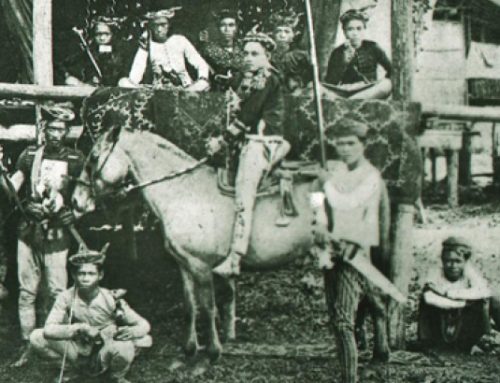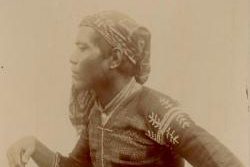
One non-Muslim warlike tribe in Mindanao that had achieved notoriety during the American occupation of the Philippines was the Tagakaolos. American anthropologist Fay-Cooper Cole, in his book “The Wild Tribes of Davao District, Mindanao,” published in 1913 has a dire description of the tribe, it reads, “They are of a turbulent, warlike disposition, and have been a constant source of trouble to the Spanish and American authorities.”
The name “Tagakaolo,”signifies “those who dwell at the head of the river” but the name also applies to the hill dwellers between the coast and the country of the Bila-an. On the original territory of the Tagakaolos, Cole wrote, “Prior to Spanish times they held the hill region back of the coast, between Malalag and Lais. On the Gulf side they were barred from the sea by the Kulaman and the Moros, while in the mountains they encountered the powerful Bila-an tribe.”
A substitute term for Tagakaolo is Kagan, Cole explained on how this alternative name came to be, ‘Today the members of this tribe can still be recognized by their close fitting suits of red and yellow striped cloth, from which they have received the name of Kagan.”
The oral history of the Tagakaolos named a brave warrior named Paugok that had led the tribe against a successful war against the Bagobos, another non-Muslim, ethnic minority tribe in Mindanao.
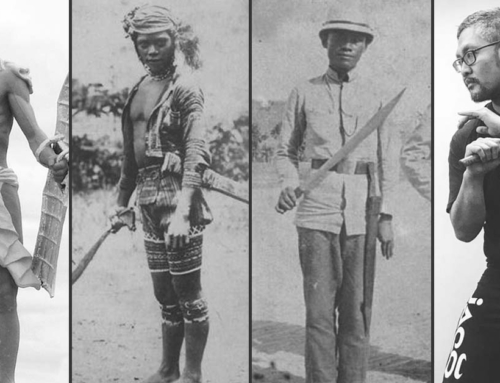
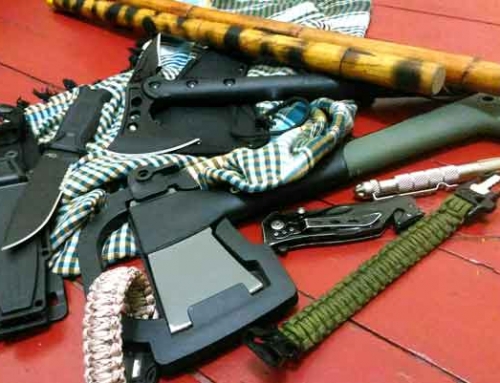
It is mandatory for the Tagakaolo warriors to go out and fight at least once a year. Raids were usually conducted when the moon is bright. Like other Philippine tribes, their weaponry includes spears, fighting knives, bows and arrows, sharpened bamboo sticks, and shields. Later on, the Tagakaolos also learned how to use guns.
Besides fighting, the Tagakaolos also utilized the knife for ritualistic purposes as in the death of a warrior, on this Cole wrote, “His knife lies in its sheath beside the body for seven days and during that time can only be drawn if it is to be used in sacrificing a slave.” The tribe venerated a powerful spirit they called Mandangan that loves war and bloodshed.
The Tagakaolos had a brutal custom of cutting the victims of their raids into pieces though women and children were sometimes spared and taken as captives. They have a practice of taking tufts of hair from the slain and attaching those to their shields. A limb of a vanquished was also sometimes brought home “so that the women and children can cut it to pieces and become brave.”
The Tagakaolos reached the height of their notoriety when they got involved in the assassination of Davao District Governor Edward C. Bolton on June 6, 1906. Mangulayon, a deputy headman of the Tagakaolo was said to have led the band of assassins that killed Bolton.
An article titled “Lieut. Bolton Buried” in the September 3, 1906 issue of the New York Times tells of how the governor was killed by the natives, it reads, “Lieut. Bolton was one of those army officers who believe that the Filipinos can be taught to govern themselves by peaceable means.
Only a few days before his death his sister, Miss Anne Jay Bolton, received a letter from him in which he said that he would like to come back to New Rochelle and visit her and his aged mother, but that he felt that it was his duty to stay in his province until peace and better government had been established.
He said that he was endeavoring to pacify the Filipinos by peaceable means, and that he was meeting with much success, A few days later Miss Bolton received a message from the War Department that her brother had been killed by the Filipinos. Later reports brought word that the Filipino chief who had led the assassins had dined with Lieut. Bolton in his tent the night before he was killed.
They parted apparently the best of friends, and Lieut. Bolton was exulting over his success in winning over the natives of his province, when the insurgent chief returned unexpectedly with a band of his followers and shot him through the heart.”
Explaining the deeper meaning behind the assassination of Bolton, Dr. Macario D. Tiu of the Ateneo de Davao University, in his book “Davao 1890-1910: Conquest and Resistance in the Garden of the Gods,” wrote, “But when the Americans began to transform Davao into plantations and forced the natives to work in these plantations, they began to resist.
By late 1905, unrest was sweeping Davao Gulf. From Lupon, Datu Tomaros and Datu Compao spread a dance that alarmed the Americans, while in Malalag, the datus were meeting in early 1906 to discuss how to kill all the American planters from Digos down to Malita. The uprising was signaled by the assassination of District Governor Edward C. Bolton by Mangulayon on 6 June 1906, and the looting of planter McCullough’s store in Kibulan. In response, the Americans unleashed the scorched-earth policy on the natives of Davao del Sur.”